
Recommendations for Transitioning Service Members
While I was still on active duty, my mentor, Retired Brigadier General Pat O’Neal encouraged me to plan and execute in such a way that in retirement I “started at a jog” versus a “cold start.” As a trained military planner (School of Advanced Military Studies (SAMS) 2016), I worked my transition like any other military operation. I planned it meticulously and executed it boldly. Like most of my plans over the last 30 years, I didn’t get everything right. At the recommendation of my Sergeants Major, I conducted an After Action Review (AAR) in my last month of active duty discussing my personal transition lessons learned with the uniformed members of my organization. These insights in my “Midpoint AAR – Retirement” file have been shared with many transitioning service members.
Since I retired in 2019, through recruiting efforts from my business, I have worked with dozens of transitioning service members to help them through this difficult process. These discussions, some time to reflect, and my experience with numerous business entities has helped me to refine my original thoughts. The article linked to the right captures my refined thinking, and accounts for things I didn’t get right at the outset.
Phases of Military Transition
Like every other planner (ever), I used three phases: Set Conditions, Execute the Transition, and Continue the Mission. Timings will vary based on your personal mission analysis, but we will use the following.
Phase 1
Set the conditions starts now and ends with you receiving retirement orders. Conditions you have to set include:
Medical
Professional
Personal
Phase 2
Execute the Transition starts with receiving your retirement orders and ends upon completion of your Permissive Temporary Duty (PTDY).
Your VA Claim
Crafting Resumes
Final Mission: Retirement Ceremony
Phase 3
Continue the Mission begins on your first day of leave following PTDY. For many, this is the first day you can begin working outside of the military. This phase does not have an endpoint.
Common Misperceptions in Military Transitions
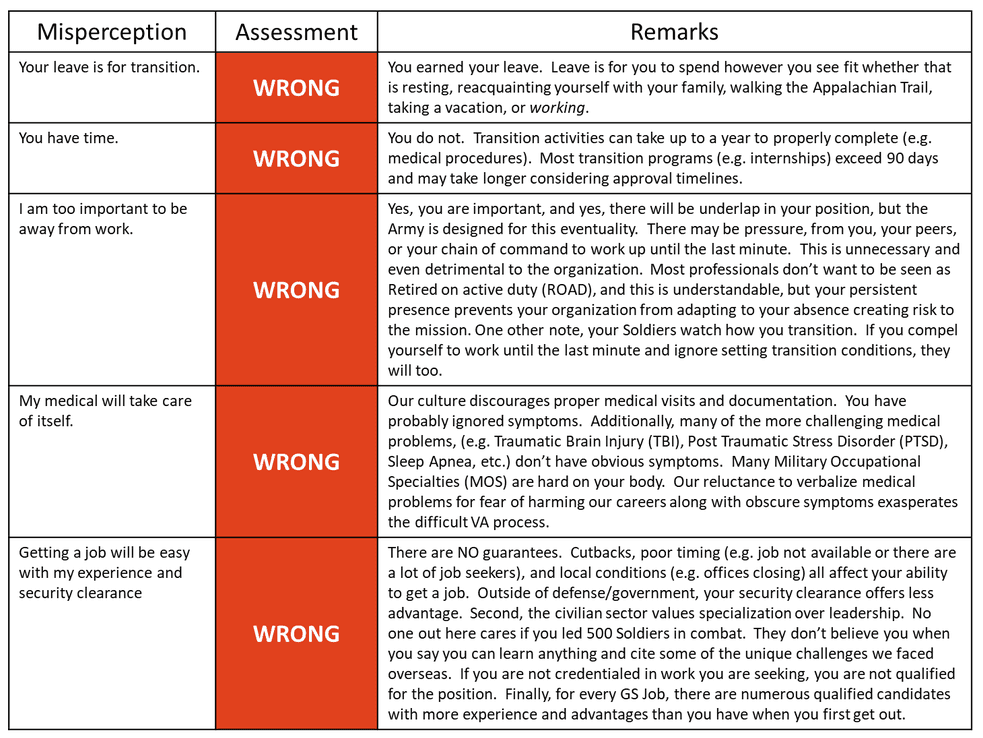
Common Misperceptions in Military Transitions
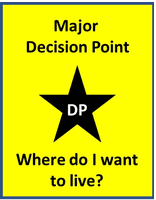
Living
If you have school-aged kids, this decision takes on even more importance. Whether you intend to stay local or intend to move to a retirement location, some due diligence will help.

Working
Your personal family timelines will affect your availability. The last thing you want is to leave an organization that took you away from your family to go into a job that takes you away from your family as much or more.

Earning
Be clear eyed as to what your retirement income will provide with respect to your standard of living. Make sure you consult a tax professional before you complete your W2. Lots of $$ can be earned, but know the consequences.
Resumes
I recommend you create two. When I counsel transitioning service members, I normally recommend they have a comprehensive resume that covers their entire military career. On this one, do not worry about page length or military to civilian conversion. Take each of your job descriptions from your evaluations at each location and summarize them into a few lines (no more than four). Try to give the reader a feel for your duties and responsibilities for each of these positions. For locations that had more than one duty description you can either combine them or treat them like different jobs. For each of these jobs, provide specific examples of things you personally did. These typically come from counseling or support forms.
Once you have a detailed resume, create a summarized, shorter resume. In this one, translate lingo from military to civilian so non-defense companies, or hiring managers with no military background can identify your experience.